
Staff Exposure Incidents: The Paperwork Most Offices Get Wrong
As a former NSBDE infection control inspector, I saw the same paperwork gaps in exposure incident documentation over and over. Here is what Nevada dental offices get wrong and how to fix it.
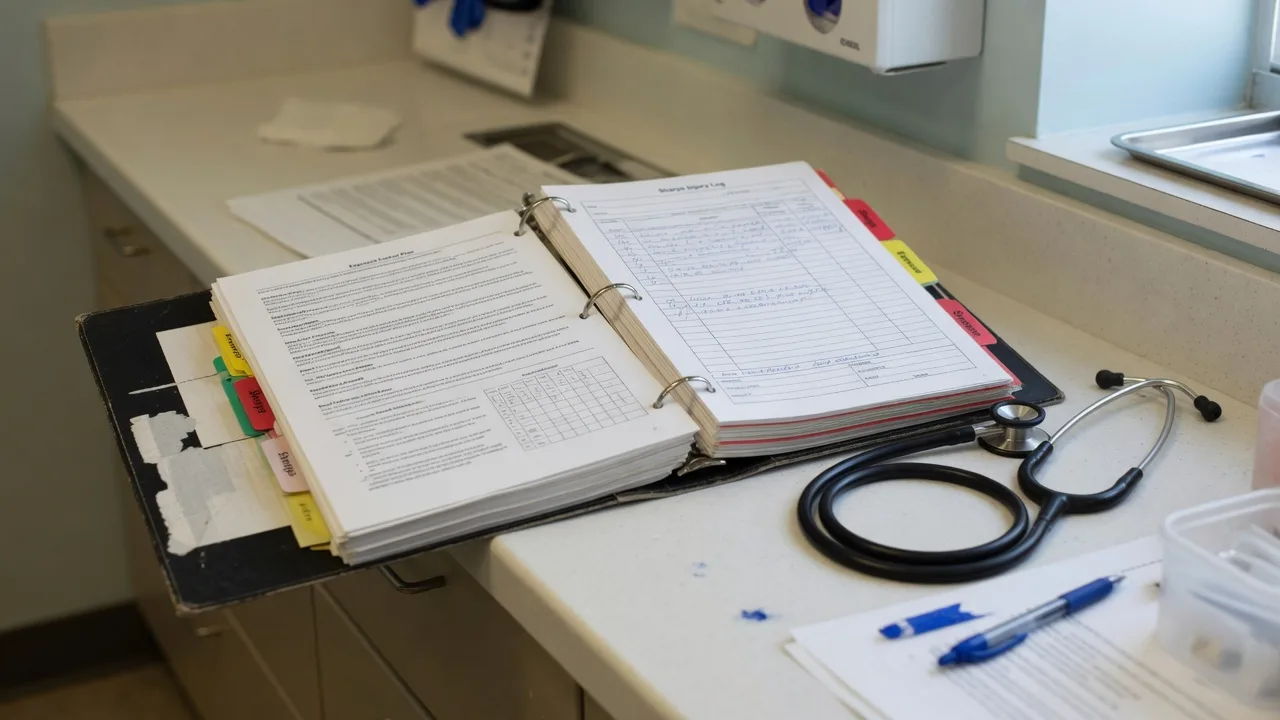
A staff exposure incident in a dental office means someone on your team was stuck with a contaminated needle, splashed in the face with blood or saliva, or cut with a contaminated instrument. Under OSHA's Bloodborne Pathogens Standard (29 CFR 1910.1030), the moment that incident happens a clock starts ticking on a specific set of paperwork requirements. As a former NSBDE infection control inspector who reviewed exposure documentation across dozens of Nevada dental offices, I can tell you that the paperwork is where most practices fall apart. The core requirement is straightforward: within 15 days of the evaluation, the examining healthcare professional must provide a written opinion to the employer, and the employer must provide that opinion to the exposed employee. What happens in between — the documentation, the timelines, the confidentiality rules — is where offices get into trouble.
Let me walk through the three stages of exposure incident paperwork and show you where the mistakes happen most often.
What Must Be Documented Immediately After an Exposure Incident?
The moment an exposure occurs, your practice needs to produce a written incident report that captures the route of exposure (needlestick, cut, splash, or bite), the circumstances under which it happened, and the time and location. This is not optional. Under 29 CFR 1910.1030(f)(3), these details are required before any evaluation can proceed. The report must also include the identity of the source individual, if known, though that information is subject to state and federal privacy laws.
Here is what I saw as an inspector: a dental assistant gets a needlestick from a used carpule. The office manager writes "assistant stuck with needle" on a sticky note and puts it in a drawer. Three months later, no one remembers the details. That sticky note is not a compliant record. You need a standardized incident report form that captures all the elements the regulation requires. We include these forms in the custom compliance manuals we build for Nevada practices.
The report also needs to document what happened next: was the employee offered immediate first aid? Was the source patient identified and asked to consent to blood testing? Was the employee referred for medical evaluation? Each of those steps must be timestamped and recorded. If the employee drove themselves to an urgent care, write down the time they left and the facility name. If the source patient declined testing, document that too.
What Documents Must Be Sent to the Healthcare Provider?
This is the step most Nevada dental offices get wrong. OSHA requires that the employer provide the evaluating healthcare professional with a specific package of documents before the evaluation can happen. That package includes a copy of the bloodborne pathogens standard (29 CFR 1910.1030), a description of the employee's job duties as they relate to the exposure incident, the incident report itself including the route and circumstances, the source individual's blood test results (if available and permitted by law), and the employee's hepatitis B vaccination status.
I can tell you from experience that many offices send the employee to the clinic with nothing more than a phone number. The provider asks for the standard, and no one has a copy. The employee's vaccination record is in a file back at the office. The incident report is still on the sticky note. The provider cannot complete the evaluation without this documentation, which means delays, which means the written opinion is late, which means the 15-day clock has already started and your practice is now behind on compliance.
Keep a compliance packet ready. Print a copy of 29 CFR 1910.1030 and keep it in your exposure control binder. Have a standard form for the job duty description. Make sure employee vaccination records are accessible to the office manager, not locked in a drawer only the doctor can open. When an incident happens, you should be able to assemble the packet in under 15 minutes, not scramble for hours.
What Happens to the Healthcare Provider's Written Opinion?
The examining healthcare professional must provide the employer with a written opinion within 15 days of completing the evaluation. That opinion must state whether the employee was informed of the results of the evaluation and whether the employee was told about any medical conditions that require further follow-up. It cannot include any information about the employee's personal medical history beyond what is directly related to the exposure.
The employer's job is straightforward: give a copy of that written opinion to the exposed employee within 15 days of receiving it. I saw practices where the written opinion arrived, the office manager filed it, and the employee never saw it. That is a violation. The employee has a right to know the outcome of their own medical evaluation, and OSHA requires you to provide it.
The original written opinion goes into the employee's confidential medical record, which must be kept separate from the general personnel file. That is another common mistake: confidential medical records stored in the same folder as performance reviews and time-off requests. Under 29 CFR 1910.1020, medical records must be maintained for the duration of employment plus 30 years, and they must be kept confidential. Your front desk staff should not be able to open the drawer and read an employee's hepatitis B status.
Does Nevada Require a Sharps Injury Log, and What Should It Include?
Federal OSHA provides a partial exemption from maintaining the OSHA 300 Log for dental offices with fewer than 10 employees. However, the Nevada State Board of Dental Examiners includes "sharps injury log" as an expected compliance element on its infection control checklist. That means even if OSHA does not require the log for your practice size, the board expects to see one during an inspection.
If you maintain a sharps injury log — and you should — it needs to include the date and time of the exposure, the type and brand of sharp involved (for example, "25-gauge X-Tip dental needle, brand name XYZ"), a description of the incident including the employee's job classification and work area, and how the incident occurred. Keep the log for at least five years. And remember, the log must protect employee confidentiality. Do not put names on a log that sits on the sterilization room counter where patients or vendors can see it.
During my time as an NSBDE inspector, I saw sharps injury logs that listed the employee's full name, social security number, and details of the injury in plain view. That is not just a compliance problem — it is a HIPAA concern. Use a log format that assigns a case number and stores identifiable employee information separately.
What Are the Most Overlooked Exposure Incident Paperwork Items?
There are three documents that consistently go missing during inspections. The first is the hepatitis B vaccination declination form. Under 29 CFR 1910.1030(f)(2), if an employee declines the hepatitis B vaccine, the employer must have a signed declination form using the specific language from Appendix A of the standard. I cannot tell you how many times I asked to see the declination forms and got blank stares. If an employee declines the vaccine and there is no signed form, the inspector assumes you never offered it. That is a citation waiting to happen.
The second is the source individual's consent or refusal for blood testing. When a staff member is exposed, the source patient has a right to be tested for HBV, HCV, and HIV. But that testing requires informed consent. If the patient refuses, you must document that refusal. If they consent, document the consent and the test results. Many offices skip this step entirely, and the entire post-exposure evaluation is incomplete without it.
The third missing item is the annual safer needle device evaluation documentation. Under 29 CFR 1910.1030(c)(1)(iv), employers must solicit input from non-managerial employees who are responsible for direct patient care in the evaluation and selection of safer needle devices. That evaluation must be documented annually. Most dental offices have never done it. The evaluation does not have to be complicated, but it has to exist and it has to include input from the people who actually use the devices every day.
"The paperwork around an exposure incident is not bureaucracy for its own sake. Every form and every timeline exists because in the moments after a needlestick, clear documentation protects both the employee and the practice."
How Should Dental Offices in Nevada Prepare for an Exposure Incident Before It Happens?
The best time to set up your exposure incident paperwork system is before anyone gets hurt. Every practice in Nevada needs a written exposure control plan that is reviewed and updated annually. That plan should include the step-by-step procedure for what to do after an exposure, including who to contact, which clinic to send employees to, and where the compliance packet is stored. Your entire team should know this procedure, not just the office manager.
I recommend including exposure incident drills as part of your staff training sessions. Run through a scenario: a hygienist gets a needlestick while recapping a needle. Walk through the paperwork together. Who fills out the incident report? Who calls the source patient? Who prepares the compliance packet for the healthcare provider? When your team has practiced the process, they will not freeze when it happens for real.
If your practice uses temporary or agency staff, make sure they are included in the training. I have seen situations where a temp was exposed and no one knew whether they had a hepatitis B vaccination record on file. That is a problem. Every person who enters a treatment room should have documented training and a vaccination record accessible to the practice.
What Happens When the Paperwork Is Not Done Correctly?
The consequences for incomplete exposure incident paperwork in Nevada fall under two regulatory systems. Nevada OSHA (NVOSHA) enforces workplace safety standards including 29 CFR 1910.1030, and can issue financial penalties for recordkeeping violations. The NSBDE enforces infection control regulations under NAC Chapter 631 and issues demerits, not citations. Accumulated demerits can put a dental license at risk. The two agencies can inspect independently, so a clean NSBDE inspection does not protect you from a NVOSHA inspection and vice versa.
Beyond the regulatory risk, there is a human cost. When the paperwork is incomplete, the employee may not get the follow-up care they need in the window that matters most. Post-exposure prophylaxis for HIV must be started within 72 hours, ideally within 2 hours. If your documentation system is a mess and the employee ends up at a clinic that does not have the required information, those critical hours can slip away. Samantha's background as a clinician and former inspector means she looks at this from both sides: the regulator's requirement and the patient's well-being.
The fix is straightforward: use standardized forms, keep your compliance packet ready, store medical records confidentially and separately, document every step of the post-exposure process, and review your exposure control plan annually. If you are not sure whether your current system would pass an inspection, schedule a compliance audit with our team. We serve practices across the Las Vegas Valley, Summerlin, Henderson, and all of southern Nevada, and we can help you identify gaps before they become problems.
For a deeper look at the broader infection control record-keeping requirements in Nevada, read our article on record-keeping for infection control: what the board actually looks for.
Review Your Exposure Incident Paperwork
Let a former NSBDE inspector audit your exposure control documents and identify gaps before your next inspection.
Schedule an Audit