Sharps Safety in Dental Offices: Common Needle Handling and Disposal Mistakes
As a former NSBDE inspector, I audited sharps safety across Nevada dental offices. Here are the most common needle handling mistakes and how to fix them.
Sharps safety violations are among the most common compliance issues I found during my time as an NSBDE infection control inspector reviewing dental offices across southern and rural Nevada. The mistakes are predictable, and they are preventable. Under the OSHA Bloodborne Pathogens Standard (29 CFR 1910.1030), every dental office must maintain proper sharps handling and disposal practices, use safety-engineered devices, and document training and injuries. Nevada OSHA (NVOSHA) applies the same federal standard, and the Nevada State Board of Dental Examiners (NSBDE) enforces additional requirements under NAC 631.178, including a sharps injury log and written handling policies. When I walked into an operatory, the first thing I looked at was the sharps container. What I found there told me almost everything about the practice's overall compliance culture.
Let me walk through the six most common sharps safety mistakes I saw in Nevada dental offices and show you how to fix each one before your next inspection.
What Is the Most Common Sharps Container Mistake in Dental Offices?
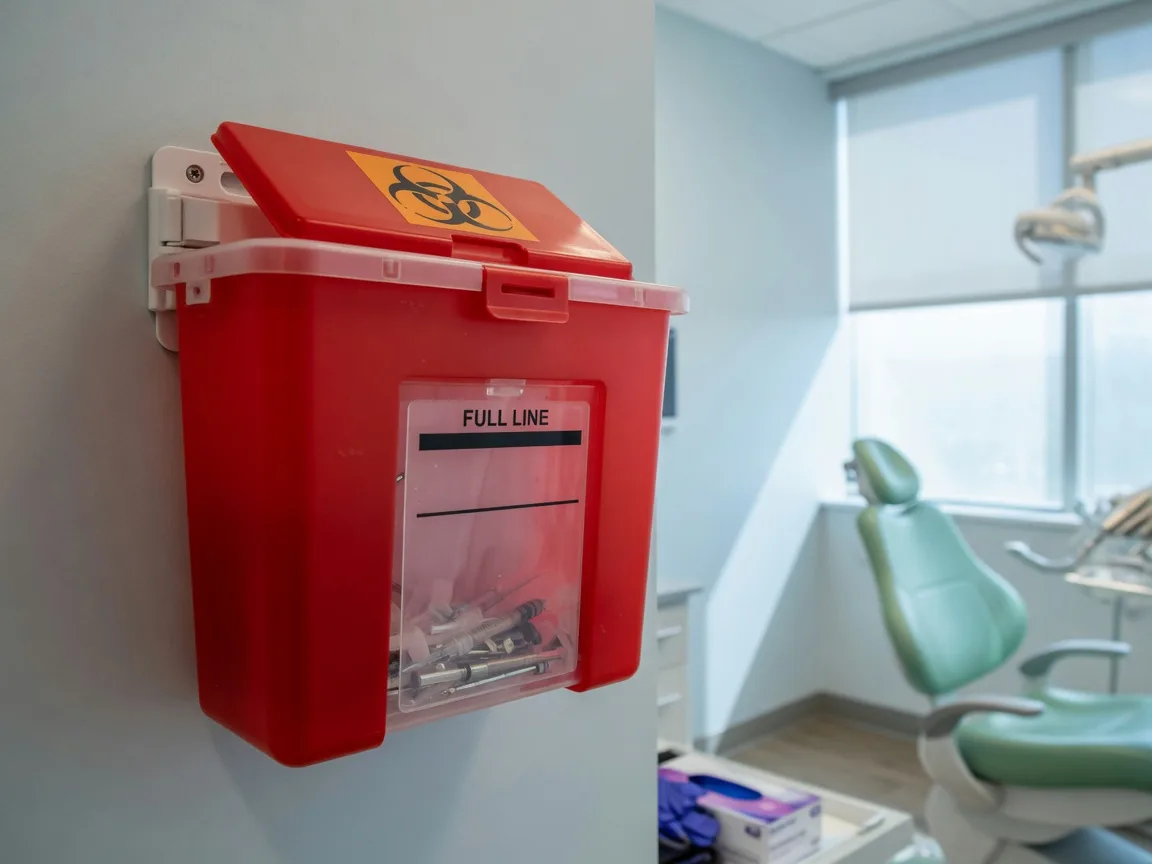
The single most common problem I saw was overfilled sharps containers. Under 29 CFR 1910.1030(d)(4)(iii)(A)(2), containers must be replaced routinely and must not be allowed to overfill. OSHA's standard says the container should be taken out of service when it reaches approximately three-quarters full. That is not a suggestion; it is the regulatory expectation.
I walked into one practice where the assistant had been pressing used carpules down into an already-full container with a hemostat to make more room. That is a needlestick waiting to happen. When a container is packed past the fill line, any attempt to add another sharp creates a risk of penetrating the side of the container or pushing a previously discarded needle upward. The solution is simple: have a schedule for container replacement based on your practice volume. If you are a high-volume practice seeing 20-plus patients a day, you may need to swap containers weekly. If you see fewer patients, biweekly or monthly may work. The key is to check the fill level visibly and replace containers on a schedule, not when someone finally notices there is no room left.
The second problem I saw with containers was placement. A sharps container sitting on a counter behind the dentist's chair or tucked into a cabinet under the sink is not compliant. The regulation says containers must be easily accessible and located as close as feasible to the immediate area where sharps are used. For a dental operatory, that means the container needs to be within arm's reach of the provider's working position. If the doctor has to turn around, walk to a cabinet, and open a door to dispose of a needle, the container is not accessible and the whole team is at increased risk during the moment the needle is in transit. Mount the container on the wall or countertop within the immediate treatment zone.
Why Is Recapping Used Needles Still a Problem in Nevada Dental Practices?
Under 29 CFR 1910.1030(d)(2)(vii), contaminated needles must not be bent, recapped, or removed from the syringe unless no feasible alternative exists or the procedure itself requires it. If recapping is absolutely necessary, it must be done using a mechanical device or a one-handed scoop technique. Two-handed recapping (where you hold the cap in one hand and guide the needle into it with the other) is strictly prohibited. It is the single most common cause of needlestick injuries in dental settings.
Despite this being one of the most clearly stated OSHA rules, I still saw two-handed recapping in practice after practice. Hygienists told me they were taught that way in school. Assistants said the dentist preferred it. The rationale does not matter to an inspector. Two-handed recapping is a citation, and it puts someone on your team at risk every time it happens.
The fix is to eliminate recapping entirely wherever possible. Use self-sheathing safety needles that shield automatically after the injection. Use a recapping device if one is needed. If you must recap, train every single clinical team member on the one-handed scoop technique: place the cap on a flat surface, hold the syringe with one hand, and scoop the cap onto the needle using the side of the cap as a guide. Then secure the cap against a firm surface to snap it closed. Every person who handles a needle in your practice needs to demonstrate this technique during your team training sessions.
Are Safety-Engineered Sharps Devices Required in Nevada Dental Offices?
Yes. The federal standard is clear, and Nevada follows it. Under 29 CFR 1910.1030(d)(2)(i), employers must use engineering controls to eliminate or minimize occupational exposure. The Needlestick Safety and Prevention Act of 2000 reinforced this by adding requirements for evaluating and implementing safer medical devices. The standard specifically requires that non-managerial employees with direct patient care responsibilities be involved in the evaluation and selection of safer needle devices.
I cannot tell you how many dental offices I visited where the same standard anesthetic syringes from 1995 were still in use, without any safety feature whatsoever. There is no excuse for it. Self-aspirating safety syringes, retractable needles, and shielded carpule systems are widely available and affordable. If you are still using traditional syringes without safety mechanisms, your practice is out of compliance.
The evaluation process does not have to be complicated. Hold a 15-minute meeting with your clinical team. Show them three different safety syringe options. Let them try each one. Document which device they prefer and why. Keep that documentation in your exposure control plan. Then make the switch. That single change will prevent the majority of needlestick injuries in your practice.
What Documentation Does the Board Look for During a Sharps Safety Audit?
When the NSBDE walks through your practice, they check both your physical setup and your paperwork. Under NAC 631.178, the board expects to see a written policy for sharps handling and management, evidence that approved sharps containers are utilized and accessible, documentation that containers are taken out of service and processed properly, a complete sharps injury log, and a written post-exposure medical evaluation plan with 24/7 contact information.
The sharps injury log is one of the most common missing items. Even if your practice has fewer than 10 employees and is partially exempt from maintaining the OSHA 300 Log, the NSBDE expects to see a sharps injury log during an inspection. The log should include the date and time of the injury, the type and brand of sharp involved, a description of the incident, where it happened, and how it occurred. Keep the log for at least five years, and store identifiable employee information separately to protect confidentiality.
If your practice has never had a sharps injury, that is good news. But you still need a log. The log exists even if no entries have been made. I have seen offices scramble during an inspection because they had no log at all, assuming that zero injuries meant zero documentation was needed. That is not correct. The log is a systems document that shows you are prepared to track injuries if and when they happen. For a complete look at what records the board expects, read our guide on record-keeping for infection control: what the board actually looks for.
Why Do Sharps Disposal Audits Reveal So Many Training Gaps?
Every dental team member who may come into contact with sharps, including front desk staff who might handle contaminated instruments during checkout or disinfection, must receive bloodborne pathogens training at the time of hire and at least annually thereafter. That training must cover proper sharps handling, disposal procedures, the location of containers, and what to do in the event of an exposure.
During audits, I found that most dental offices had training records for the permanent clinical staff: the dentist, the hygienists, the full-time assistants. But what about the part-time hygienist who works Fridays only? What about the temp assistant brought in to cover a sick call? What about the sterilization technician who processes all the instruments at the end of the day? If a temp employee is exposed and their training record is empty, the practice owns that exposure.
Another common gap is failing to document the safer sharps device evaluation as a training topic. Under 29 CFR 1910.1030(g)(2)(vii), annual training must include information on the types, proper use, and limitations of the engineering controls used in the practice. If you switched to a new safety syringe last year and have not updated your training materials or discussed the change with the team, your training records are out of compliance.
I recommend including a hands-on sharps handling drill in every annual training session. Have each team member demonstrate the one-handed scoop technique, show them where every sharps container in the practice is located, and walk through the post-exposure protocol step by step. Documentation of that drill goes into each employee's training file. For a full list of training topics we cover, see our staff training programs.
\"The sharps container tells the story of a practice's compliance culture. If it is overfilled, misplaced, or unlabeled, the inspector knows without opening a single drawer that the rest of the infection control program probably has gaps too.\"
How Should a Dental Office Self-Audit Its Sharps Safety Program?
A quarterly sharps safety self-audit takes about 20 minutes and can prevent the most common citations I saw as an inspector. Walk through each operatory and ask the following questions:
- Is the sharps container mounted within arm's reach of the treatment area?
- Is the container upright, securely mounted, and labeled with the biohazard symbol?
- Is the container at or below the three-quarters fill line?
- Are there any used needles, carpules, or scalpel blades on the counter, in the sink, or in the trash?
- Is a safety-engineered sharps device in use on the bracket table?
- Is the exposure control plan binder accessible and up to date?
- Is the sharps injury log present, and is employee information stored confidentially?
Document the results of each audit and keep the records in your compliance file. If you find a problem during the audit, correct it immediately and note the corrective action. That documentation shows an inspector that you are actively managing your compliance program, not just reacting when someone schedules an inspection.
If your practice is in the Las Vegas Valley, Summerlin, Henderson, or anywhere in southern Nevada, you can also work with a consultant to perform a deeper review. Our team at Thrive Professional Solutions conducts infection control audits that include a comprehensive sharps safety evaluation. We walk through your practice the same way an NSBDE inspector would, identify gaps, and give you a clear action plan for closing them. We also build custom compliance manuals specific to Nevada's regulatory environment, covering everything from sharps handling policies to exposure control plans.
The cost of a sharps safety violation goes beyond the fine. A needlestick injury affects a real person on your team. Post-exposure prophylaxis for bloodborne diseases carries its own physical and emotional toll. And in Nevada, the board issues demerits, not citations, for infection control violations under NAC Chapter 631. Accumulated demerits put your license at risk. A 20-minute quarterly audit and a commitment to using safety-engineered devices are small investments compared with what is at stake.
For more on what happens after an exposure incident, including the paperwork requirements, the timelines, and the confidentiality rules, read our detailed guide on staff exposure incidents: the paperwork most offices get wrong.
If you are unsure whether your sharps program would pass an inspection, contact us to schedule a compliance audit. We serve dental practices across all of southern Nevada and can help you identify and fix gaps before an inspector does.
Audit Your Sharps Safety Program
Let a former NSBDE inspector evaluate your sharps handling practices and identify compliance gaps before your next inspection.
Schedule an Audit