
Waterline Testing for Dental Practices: Why Legionella and Biofilm Risks Matter
Most Nevada dental practices overlook waterline testing until an inspection exposes the gap. Here is what the NSBDE requires, what biofilm and legionella risks look like, and how to test correctly.
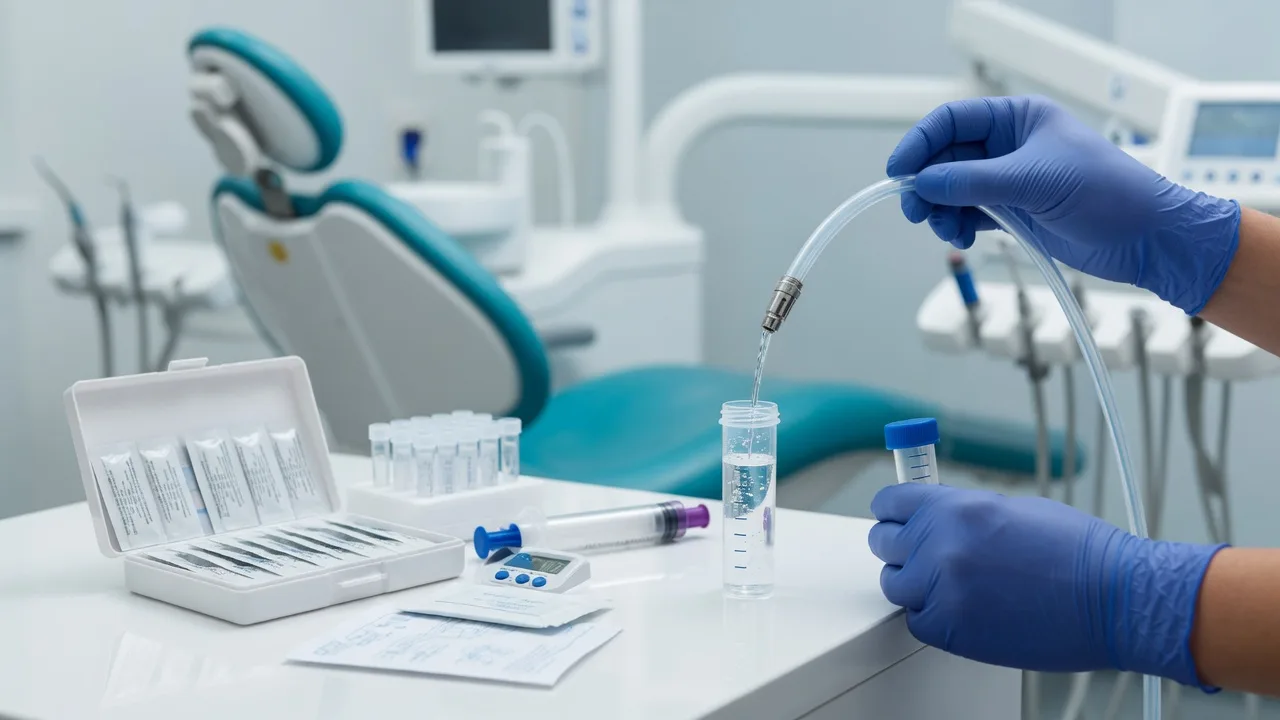
Dental unit waterlines are the most overlooked infection control gap in many Nevada dental practices, and they are the one area where I consistently saw deficiencies during my time as an NSBDE infection control inspector. Here is the short answer: the CDC standard requires dental water used in nonsurgical procedures to contain no more than 500 colony-forming units of heterotrophic bacteria per milliliter (500 CFU/mL), which matches the EPA drinking water standard. The NSBDE enforces this requirement under NAC 631.178, which adopts the CDC's Guidelines for Infection Control in Dental Health-Care Settings by reference, making water quality a legal obligation for every registered dental facility in Nevada.
When I inspected dental offices across southern and rural Nevada, I walked into practices where the waterline testing protocol was a mystery to the entire team. Some offices tested once and assumed they were done. Others could not tell me when their lines were last treated. A few had never tested at all. The reason is not malice. It is that dental unit waterlines are out of sight and out of mind until an inspector opens the cabinet under the sink and asks to see your test results. Let me walk you through what the requirements are, why biofilm and legionella are genuine risks, and exactly how to set up a testing protocol that will satisfy both the NSBDE and your own peace of mind.
What Does the NSBDE Require for Dental Waterline Testing in Nevada?
NAC 631.178 is the regulation that governs infection control in Nevada dental practices, and it works through adoption by reference. The NSBDE adopts the CDC's Guidelines for Infection Control in Dental Health-Care Settings (2003) and the CDC's Guideline for Disinfection and Sterilization in Healthcare Facilities (2008) as binding requirements. That means the CDC's water quality recommendations are not optional suggestions in Nevada. They are enforceable rules, and the NSBDE inspects for compliance with them.
The specific requirement is straightforward: water discharged from dental unit waterlines must meet the EPA drinking water standard of 500 CFU/mL or less for heterotrophic bacteria. This standard applies to water used in nonsurgical procedures, including water delivered through handpieces, ultrasonic scalers, and air-water syringes. It does not apply to water used for surgical procedures, which requires sterile water from a separate source.
To prove compliance, the NSBDE expects to see documented testing records. The CDC recommends testing dental waterlines at least quarterly after initial setup. Some dental unit manufacturers recommend weekly testing, and your practice should follow whichever interval is more stringent. If your unit manufacturer says test every month, test every month. The manufacturer's instructions for use carry their own regulatory weight under OSHA's hazard communication framework and the FDA's device regulations.
Your testing records should include the date of each test, the test method used, the results measured in CFU/mL, and any corrective actions taken if the results exceeded the action limit. Keep these records in your compliance binder alongside your spore testing logs and sterilization monitoring records. If you need help setting up a complete record-keeping system, our guide on infection control record-keeping covers exactly what the board looks for during an inspection.
What Are Biofilm and Legionella and Why Should Dental Offices Care?
Biofilm is the root cause of almost every waterline contamination problem. It is a complex community of microorganisms that attaches to the interior surface of dental unit tubing. The narrow lumen of dental waterlines, the intermittent flow of water, the tendency for water to stagnate overnight and over weekends, and the occasional retraction of oral fluids back into the line all create ideal conditions for biofilm to form and grow.
Once biofilm establishes itself inside your waterlines, it acts as a reservoir for bacteria. The species commonly found in dental waterline biofilm include Legionella species, Pseudomonas aeruginosa, and nontuberculous Mycobacteria (NTM). These are not just harmless environmental bacteria. Legionella pneumophila causes Legionnaires' disease, a severe form of pneumonia, and Pontiac Fever, a milder flu-like illness. Transmission happens when contaminated water is aerosolized through dental handpieces, ultrasonic scalers, and air-water syringes. The patient or dental team inhales the aerosol, and the bacteria reach the lungs.
This is not theoretical. In 2012, a patient in Italy died after contracting Legionnaires' disease traced to a dental unit. In 2015, a Legionella outbreak at a long-term care facility was linked to dental water equipment. The CDC has also documented outbreaks of nontuberculous Mycobacteria infections linked to dental waterlines, including a cluster of pediatric dental infections that led to a CDC Health Alert Network advisory in 2022. For immunocompromised patients, the risk is even higher. And in Las Vegas and Southern Nevada, where we see a significant population of older adults and patients with chronic health conditions, the patient population at risk is substantial.
I bring this up not to alarm you but to frame the issue correctly. Waterline testing is not a paperwork exercise. It is a patient safety measure with real clinical consequences. The biofilm inside your lines is invisible. You cannot see it, you cannot smell it, and it will not change the taste of the water. The only way to know your water is safe is to test it.
How Should a Dental Office Test Its Waterlines Correctly?
Testing dental waterlines is not complicated, but it must be done correctly to produce reliable results. Here is the process that I recommend to every practice I work with.
Choose the right test method. The most common approach is a heterotrophic plate count (HPC) test, which measures the total number of colony-forming units per milliliter of water. Test kits designed specifically for dental waterline testing are widely available and include germicidal neutralization, which is important because it neutralizes any residual disinfectant in the water sample so you get an accurate bacterial count rather than a false negative.
Collect the sample correctly. This matters more than most practices realize. You should collect the water sample from the distal end of the waterline at the point of use, meaning the handpiece connector or the air-water syringe tip. Flush the line for the time specified in your unit manufacturer's instructions before collecting the sample. Use a sterile collection container. Do not touch the inside of the container or the lid. Seal it immediately and label it with the date, the operatory number, and the unit identifier. Send or deliver it to a laboratory that processes dental water samples within the holding time specified by the test kit manufacturer.
Test every operatory. Each dental unit in your practice should be tested independently. Testing one unit and assuming the others are the same does not work. I have seen practices where one unit tested at 50 CFU/mL and the unit next to it, using the same water source but with different tubing age and flow patterns, tested at 1,200 CFU/mL. Test every unit every time.
Document the results. Your testing records should go into your compliance binder alongside everything else. The 2026 dental practice compliance checklist includes a waterline testing section so you can track each unit's results over time and spot trends before they become problems.
Take action if you exceed 500 CFU/mL. If a test result comes back above the action limit, treat the unit according to the manufacturer's instructions for use. Most manufacturers recommend a chemical shock treatment or a continuous in-line treatment system. After treating, retest the unit to confirm the bacterial count is below 500 CFU/mL. Continue testing at your regular interval after that. If you consistently exceed the limit despite following the manufacturer's treatment protocol, contact the manufacturer for support. There may be an underlying issue with the unit's water supply or tubing that requires replacement.
What Common Waterline Mistakes Does the Board See During Inspections?
During my time inspecting for the NSBDE, I saw several waterline-related gaps appear consistently. Here are the most common ones.
No testing records at all. This is the biggest one. Some practices have never tested their waterlines and do not realize it is a requirement. If you are reading this and have never tested your dental unit water, start this week. Order a test kit, run the test, and start your record.
One test and done. Testing once is not compliance. The CDC recommends quarterly testing, and you need a consistent record over time to show that your water quality is maintained, not just measured on one good day.
Not flushing lines at the start of the day. The CDC recommends flushing dental waterlines for at least 30 seconds at the beginning of each clinic day and between patients. This reduces the bacterial load that accumulates during stagnation periods. If you are not doing this, the water that comes out of your handpiece in the morning has had all night to grow biofilm.
Ignoring the manufacturer's instructions. Every dental unit comes with manufacturer instructions for use that specify water treatment and testing protocols. Those instructions are not suggestions. They carry regulatory weight, and not following them is a compliance gap regardless of what your testing results show.
Assuming city water is clean enough. Municipal water in Las Vegas and Henderson meets the EPA drinking water standard at the tap, but that standard is measured at the point of delivery to the building. Once water enters your dental unit and sits in narrow tubing heated to room temperature or warmer, bacterial growth accelerates rapidly. The water coming out of your handpiece is not the same quality as the water coming out of your break room faucet.
If any of these gaps sound familiar, you are not alone. Most Nevada dental practices I have worked with had at least one of these issues when we first evaluated their compliance program. The fix is straightforward, but it requires intention and consistency. Our staff training workshops include a hands-on module on waterline testing protocols so your entire team knows how to collect, document, and respond to test results.
What Are the Health Risks of Ignoring Waterline Compliance?
The health risks associated with contaminated dental waterlines are well established in the scientific literature. Legionella species found in dental unit water have been linked to healthcare-associated infections. The CDC has documented multiple outbreaks of nontuberculous Mycobacteria (NTM) infections in children who underwent dental procedures, resulting in serious oral and facial infections that required surgical intervention. Pseudomonas aeruginosa can cause serious infections in immunocompromised patients, including those undergoing cancer treatment, transplant recipients, and elderly patients with chronic illnesses.
For the dental team itself, the risk is occupational. The clinicians who use handpieces, ultrasonic scalers, and air-water syringes every day are the ones most likely to inhale aerosolized contaminated water. If your waterlines harbor Legionella, your team is inhaling it with every ultrasonic scaling appointment. They are facing a daily exposure that you can eliminate with a proper waterline maintenance program.
I know that reading this section can feel uncomfortable, especially if you are realizing your practice may have gaps in this area. That discomfort is the right response. It means you care about your patients and your team. The next step is to act on it. Testing is simple, treatment is well understood, and once your protocol is in place, maintaining it requires about 15 minutes per operatory per quarter.
If you want a complete evaluation of your practice's waterline program, contact us to schedule a compliance audit. We will walk through every waterline in your practice, review your current testing protocol, check your records, and give you a clear written plan for any gaps we find. I have done this for practices across Summerlin, Henderson, Northwest Las Vegas, and the entire Las Vegas Valley, and the most common response I get is "I wish we had done this sooner."
How Does Waterline Testing Fit Into a Complete Infection Control Program?
Waterline testing is one component of a comprehensive infection control program that also includes sterilization monitoring, sharps safety, PPE compliance, hazard communication, training documentation, and exposure incident management. If you have already addressed sharps safety and record-keeping but have not looked at your waterlines, you have a significant gap that will show up during an NSBDE inspection.
The sharps safety article and the record-keeping guide cover the other core pieces of an infection control program. Together, these areas account for the majority of deficiencies I found during my time as an NSBDE inspector. A practice that has clean documentation, proper sharps handling, and routine waterline testing is well positioned for any inspection from NVOSHA or the board.
For a full review of every infection control area your practice needs to address, our infection control consulting page outlines the complete audit process. We evaluate your practice against the same standards the board uses, and we give you a written roadmap to full compliance.
Waterline testing is not a burden. It is a measure of the care you extend to your patients every time they sit in your chair. If you are not testing yet, start today. If you are testing but not documenting, start a log today. And if you want a second set of expert eyes on your entire compliance program, I am here to help. I have been in your operatory. I know what the board looks for. And I am always on the side of the practice that wants to do it right.
Need a Waterline Compliance Audit?
Let a former NSBDE inspector review your waterline testing protocol, check your documentation, and help you build a compliant program for every operatory in your practice.
Schedule Your Audit