Sharps Containers in Dental Offices: Selection, Placement, and Disposal Rules
A former NSBDE inspector explains sharps container rules for Nevada dental offices: OSHA requirements, the three-quarters rule, and NAC 444 disposal.
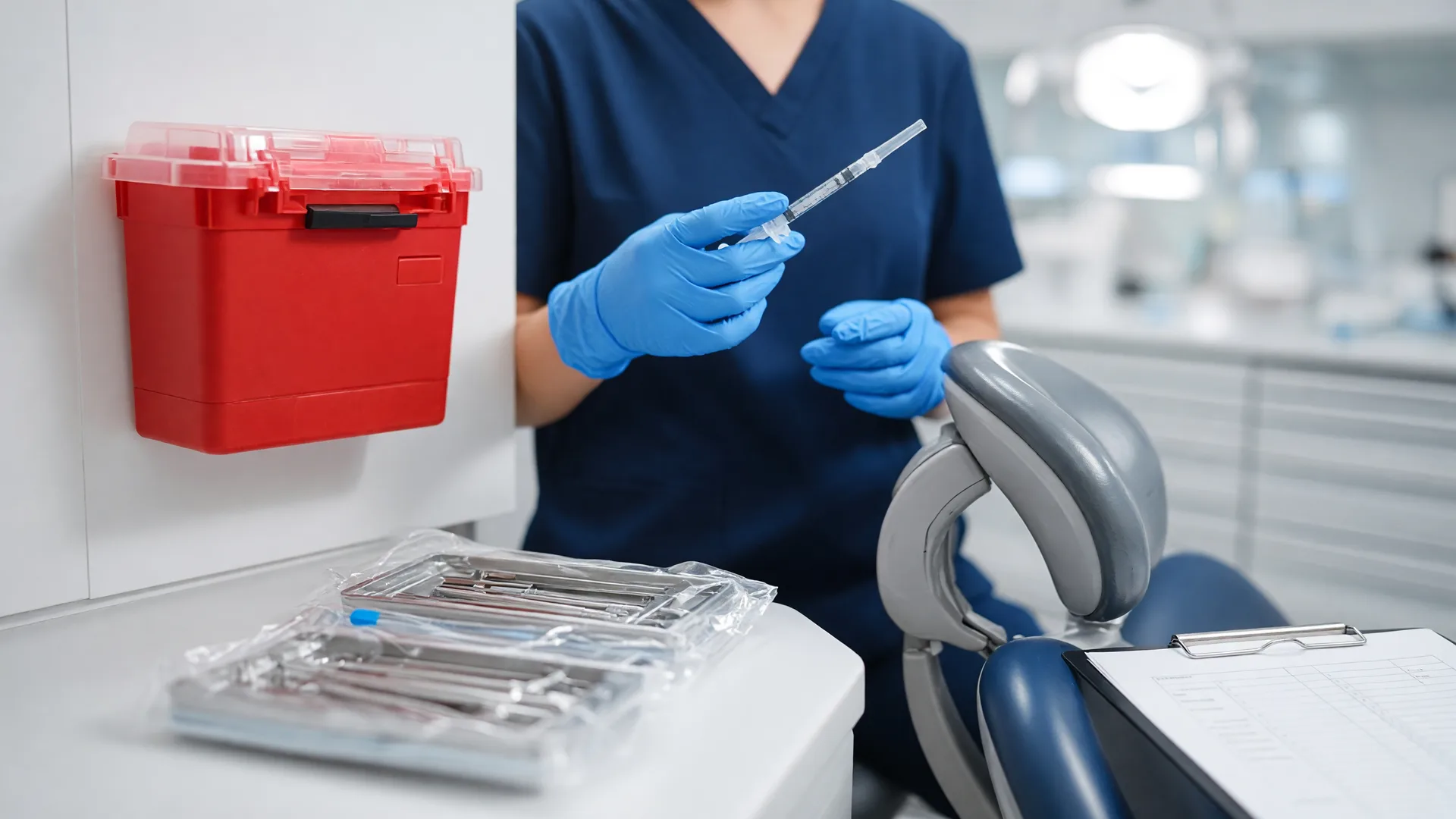
Sharps containers in a Nevada dental office must be closable, puncture-resistant, leakproof on the sides and bottom, and labeled or color-coded red, under 29 CFR 1910.1030(d)(4)(iii)(A)(1). They must sit within easy reach of where sharps are used, stay upright, and be replaced before they overfill. And once a container is full, how you store and dispose of it is governed by Nevada's medical waste rules in NAC Chapter 444, with a stricter local layer from the Southern Nevada Health District in Clark County. As a former NSBDE infection control inspector, I checked sharps containers in every operatory I walked into. Here is what compliance actually looks like, from the container on the wall to the disposal manifest in your file.
The container is the first thing I looked at when I entered a practice. It tells you more about a compliance culture than almost anything else in the building. If the container is wrong, everything else gets questioned. Here is what the rules say, what the board and OSHA check, and how to keep your sharps program audit-ready.
What Are the OSHA Requirements for Sharps Containers in a Dental Office?
Under 29 CFR 1910.1030(d)(4)(iii)(A)(1), contaminated sharps must be discarded in containers that meet four requirements: they must be closable, puncture-resistant, leakproof on the sides and bottom, and labeled or color-coded (red, or bearing the biohazard label under 1910.1030(g)(1)(i)). During use, the same standard says containers must be easily accessible, located as close as feasible to the immediate area where sharps are used, maintained upright, and replaced routinely so they are never allowed to overfill.
In practice, that means buying a real sharps container from a reputable supplier, not improvising. I have seen practices use cardboard boxes, open plastic cups, and even a rinsed-out detergent bottle. None of those are closable, puncture-resistant, or leakproof. The container needs a lid that actually closes and latches, walls a needle cannot push through, and a visible biohazard label. If you cannot say those four things about every container in your practice, start there.
When Should a Sharps Container Be Taken Out of Service?
The federal rule is straightforward: containers must be replaced routinely and never allowed to overfill. The three-quarters fill line printed on most containers is the industry standard and the manufacturer's guidance for when to take a container out of service. That is the number to run on: when contents reach the fill line, close the lid and swap in a fresh container. Do not press material down to make more room, and do not wait until a needle is sticking out of the top.
Set a replacement schedule based on your practice volume. A high-volume practice seeing twenty-plus patients a day may need to swap containers weekly; a smaller practice may only need to change them every few weeks. Check fill levels visibly and on a schedule, not when someone finally notices there is no room left. When you close a full container, latch the lid securely and move it to your medical waste storage area until pickup. Our companion guide on common sharps mistakes in dental offices covers the handling side in detail.
Where Should Sharps Containers Be Placed in a Dental Operatory?
OSHA requires containers to be easily accessible and located as close as feasible to the immediate area where sharps are used. For a dental operatory, that means within arm's reach of the provider's working position. The container belongs on the wall or countertop in the immediate treatment zone, not on a counter behind the chair, not inside a cabinet under the sink, and not down the hall.
Think about the moment a needle comes out of a patient's mouth. The distance between the provider's hand and the container is the distance a contaminated sharp travels through the room. Every extra step is a chance for a needlestick. Mount the container so the provider can dispose of the sharp without turning around or walking. And do not forget the hygiene rooms and the sterilization area: anywhere carpules, scalpel blades, or suture needles are handled needs its own accessible container.
How Does Nevada Regulate Sharps and Medical Waste Disposal?
Nevada regulates medical waste under NAC Chapter 444 (Sanitation). NAC 444.00745 defines sharps as objects capable of cutting or penetrating skin, tissue, cartilage, or mucosa that have been or may be contaminated with a pathogen, which covers needles, scalpel blades, and similar items. NAC 444.662(6) requires medical waste to be stored in watertight, tightly covered, clearly labeled, corrosion-resistant containers kept in a safe location inaccessible to the public. Under NAC 444.646, medical waste may only be deposited at a disposal site whose operational plan is approved by the solid waste management authority, and facilities that accept medical waste must be regulated or permitted under NAC 444.460.
What this means for your practice is simple: full sharps containers do not go in the regular trash, and they do not sit in an unlocked hallway. They go into a compliant storage container in a locked or otherwise inaccessible area, and they are picked up by a permitted medical waste service. Your hauler should be able to show you their permit and pickup schedule. If you cannot name your disposal vendor or produce a service agreement, that is a gap an inspector will find.
What Does the Southern Nevada Health District Require for Dental Sharps Waste?
In Clark County, the Southern Nevada Health District operates a Restricted Waste Management Program, and untreated medical waste is a restricted waste under that program. Dental offices are generators of restricted waste, and they generally need an initial evaluation by a restricted waste inspector. A permit exemption is available only for very small quantities, roughly less than one gallon or eight pounds of medical waste per calendar year, which most dental offices exceed.
There is one more layer that surprises a lot of Las Vegas practices: unlike the state baseline, Clark County requires infectious medical waste to be treated before disposal. That means your sharps and other regulated medical waste must go through the SNHD program or a permitted hauler that treats the waste, rather than routine trash collection. If you are in the Las Vegas Valley, Henderson, or anywhere in Clark County, confirm that your disposal vendor is permitted under the SNHD program and keep the documentation on file. For the paperwork side of exposure response, our guide on staff exposure incident paperwork covers the records that connect to your sharps program.
What Disposal Records Should a Dental Office Keep?
Three records matter most. First, the service agreement and pickup manifests from your medical waste hauler, showing dates and volumes. Second, the sharps injury log required under 29 CFR 1910.1030(h)(5), kept for at least five years per 29 CFR 1904.33, with the date, the type and brand of device, the work area, and a description of each incident, stored confidentially. Third, the written sharps handling policy that the NSBDE expects to see under NAC 631.178, covering container use, replacement, and disposal procedures.
I cannot tell you how many practices had perfect containers and an empty sharps injury log. The log is a systems document: it exists even when no injuries have occurred, and it shows an inspector that you are prepared to track exposures if they happen. Keep it with your other exposure control documents, and keep employee-identifying information separate to protect confidentiality. For the full list of records the board checks, read our guide on record-keeping for infection control.
How Do You Audit Your Sharps Container Program?
A quarterly sharps audit takes about twenty minutes and prevents the most common citations I saw as an inspector. Walk through each operatory, hygiene room, and the sterilization area, and check: is the container within arm's reach of the treatment position? Is it upright, securely mounted, and labeled with the biohazard symbol? Is it at or below the three-quarters fill line? Are there any used needles, carpules, or blades loose on the counter, in the sink, or in the trash? Is a safety-engineered device in use on the bracket table? Is the exposure control plan binder accessible and current? Is the sharps injury log present with employee information stored confidentially?
Document the results of every audit and note corrective actions. That paper trail is what separates a practice that manages compliance from a practice that reacts when an inspection is scheduled. If you find a problem, fix it immediately and write down what you did. If you would rather have a former inspector walk your practice the way the board does, our infection control consulting services include a full sharps safety evaluation with a written action plan.
Audit Your Sharps Container Program
Let a former NSBDE inspector evaluate your sharps containers, placement, and disposal chain before your next inspection.
Schedule an Audit