When to Call a Dental Compliance Consultant (or Not)
Not every compliance gap needs a consultant. Here is how Nevada dental practices decide when to handle infection control internally and when to call in an expert.
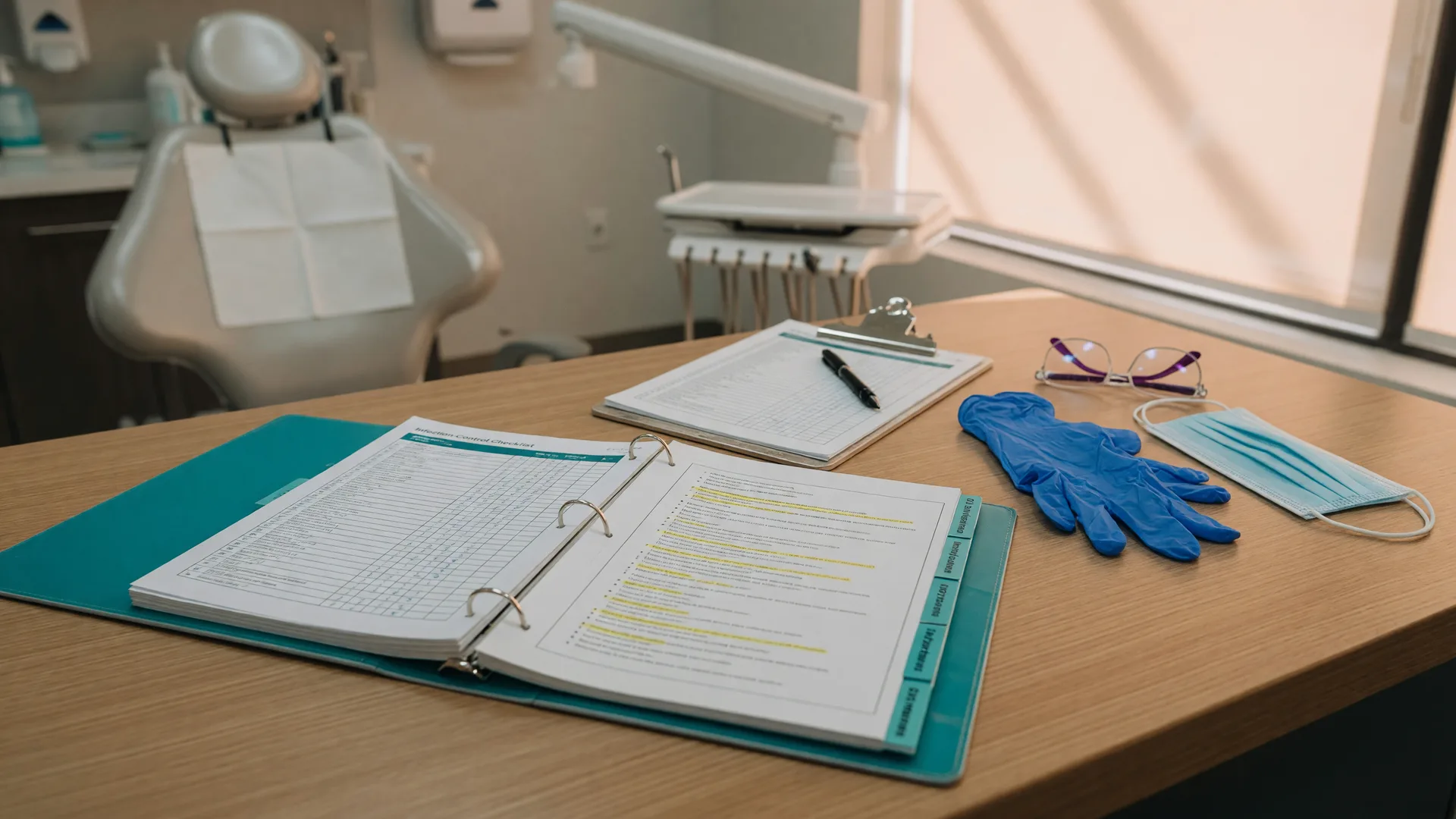
Most Nevada dental practices can handle routine compliance internally: keeping the written exposure control plan current, running weekly spore tests, documenting training, and doing a quarterly self-audit. You should call in a consultant when the stakes are specific and concrete: an inspection notice is on the calendar, a deficiency letter from the Nevada State Board of Dental Examiners (NSBDE) is in your inbox, a staff member has had an exposure incident, or your practice has grown and the paperwork has not kept up. As a former NSBDE infection control inspector, I have walked into offices that needed a few hours of guidance and offices that needed a full rebuild. The difference is knowing which situation you are in before you spend money you do not need to spend or skip help you cannot afford to skip.
When Should a Dental Office Handle Compliance Internally?
Start with work that has a clear owner and a clear schedule. If your practice has an office manager or lead clinical staff member who can be the designated compliance lead, most day-to-day work can stay in-house: the annual review of your written exposure control plan under 29 CFR 1910.1030, weekly biological spore testing of your sterilizers under NAC 631.178, documented bloodborne pathogens training at hire and annually, an up-to-date safety data sheet binder, and a maintained sharps injury log.
Most of the practices I inspected were not failing because they had no compliance program. They were failing because the program existed but nobody owned it: the exposure control plan was in a binder, but no one could say when it was last reviewed. If you have one person who owns compliance, a clean last inspection, and a team that answers questions consistently, internal handling works.
Run a self-audit on a regular schedule so you catch drift before an inspector does. Our step-by-step self-audit guide walks through the exact checks: the exposure control plan, sharps safety, PPE, sterilization flow, waterlines, and the records the NSBDE checks. If that audit comes back clean, you have your answer. If it comes back with the same gaps every quarter, that is a signal.
When Does It Make Sense to Call in a Compliance Consultant?
Bring in a consultant when the situation is time-sensitive, high-stakes, or outside your team's experience. The clearest trigger is an inspection notice. If NVOSHA, the state plan administered by the Nevada Division of Industrial Relations, or the NSBDE has scheduled a visit, you do not have weeks to learn the rules; you have days. A consultant who has sat on the inspector side of the table can triage your practice fast. Our 30, 60, and 90-day inspection readiness guide explains what thorough preparation looks like; a consultant simply compresses that timeline.
Another trigger is a deficiency letter. Under NAC 631.1785, critical deficiencies require immediate corrective action and a board reinspection, in some cases within 72 hours. That is not a do-it-yourself timeline. If the board has flagged your sterilization monitoring, your waterlines, or your documentation, you want someone who knows the board's inspection form inside and out.
Exposure incidents are a third trigger. When a staff member has a needlestick or other exposure, the paperwork under 29 CFR 1910.1030(f) has to be right the first time: the evaluation, the source testing, the written opinion. Our article on exposure incident paperwork covers the details, and this is the kind of high-stakes documentation where a second pair of expert eyes pays for itself.
What Are the Warning Signs That Your Practice Needs Outside Help?
Even without a notice on the calendar, certain signs mean your internal system is not working. Here are the ones I looked for as an inspector and still ask practice owners about today:
You cannot produce the exposure control plan in under a minute. If it is not where everyone knows it is, it is not part of how the practice runs.
Training records are missing names, dates, or topics. A record that says "annual training completed" with no trainer and no content summary will not satisfy an inspector, and it tells you the training was probably not real.
The spore test log has gaps you cannot explain. Weekly biological testing under NAC 631.178 is a Nevada requirement, and a gap means sterilizers ran unverified. That is a process problem, not a paperwork problem.
Staff answer inspection questions differently. Ask three team members where sharps containers go, when gloves change, or what to do after an exposure. If you get three different answers, your training is not landing.
You have had repeat deficiencies in the same area across inspections. One missed item is a mistake. The same item twice is a system gap that will keep costing you.
No single person owns compliance. This is the biggest one. If compliance is everyone's job, it is nobody's job. A consultant can set up the structure, but you need an internal owner to keep it alive.
If two or more of these sound familiar, an outside review will almost certainly save you money. Our article on dental board inspection horror stories shows what is at stake when these are ignored.
What Should You Look for in a Dental Compliance Consultant?
Not all consultants are equal and the title is not regulated, so ask the right questions. Look for regulatory experience, not just a certificate. The strongest background is a former inspector: someone who has performed the inspections, knows the NSBDE infection control survey form, and understands how NVOSHA applies 29 CFR 1910.1030 in a dental setting.
Clinical experience matters too. A consultant who has worked in a dental operatory understands why a sterilization room is laid out as it is and can give you a workflow that is practical, not just compliant on paper. Ask what the deliverable is: a written report with prioritized fixes, custom compliance manuals written for your practice, and training your team can use after the consultant leaves. That is what we build into every engagement at Thrive Professional Solutions.
Nevada-specific knowledge is non-negotiable. The rules that matter here are NRS and NAC Chapter 631, the CDC infection control guidelines adopted by reference under NAC 631.178, and Nevada's state OSHA plan. A consultant who works nationally may know the general rules but miss the Nevada details, like the board's demerit system, where accumulated demerits put a license at risk rather than a fine. Samantha Medeiros served as an NSBDE infection control inspector across southern and rural Nevada, the background you want on your side.
How Do the Costs of a Consultant Compare With the Cost of a Deficiency?
I am not quoting prices here, because every practice is different, but a focused consulting engagement costs a fraction of what a serious deficiency can cost you. The NSBDE does not fine practices the way OSHA does; it records deficiencies and issues demerits, and accumulated demerits put your license at risk. A critical deficiency under NAC 631.1785 can mean a reinspection within 72 hours, a corrective action plan, and in the worst cases, an order to stop some or all treatment. NVOSHA citations under the bloodborne pathogens standard can reach into the tens of thousands of dollars for repeat or willful violations.
Compare that with a consultant who finds the gaps before either agency does. Most practices I work with recover the engagement in avoided downtime, avoided reinspection stress, and team confidence. The real question is not whether you can afford a consultant. It is whether you can afford to find out you needed one after the inspection.
How Can You Get the Most Out of a Compliance Consultant?
Do your homework first. Run a self-audit before the consultant arrives so you spend the engagement on real gaps instead of obvious ones, and gather your documents: exposure control plan, training records, spore test logs, sharps injury log, and safety data sheets. A consultant who finds an empty binder spends the first hours on discovery work you could have done yourself.
Be honest about your gaps. The consultant is not there to judge you; they are there to fix problems before the board or NVOSHA does. I have never met a practice owner who was helped by hiding a missing record from the person they hired to find it.
Use the training. A good engagement does not end with a report; it ends with your team able to run the system. Ask for staff training as part of the engagement so the internal owner knows how to maintain what was built. Our staff training workshops are delivered in your practice, on your equipment.
If you are on the fence, start with a conversation. We will tell you honestly whether you need a full audit, a focused review, or just a few hours of guidance. Contact us and we will help you figure out which situation you are in. That is the whole point: knowing when to handle it yourself, when to call for help, and doing either one well.
Not Sure Which Situation You Are In?
Start with a conversation. As a former NSBDE inspector, Samantha will tell you honestly whether you need a full audit, a focused review, or just a few hours of guidance.
Talk to Samantha