How to Self-Audit Your Dental Office: A Step-by-Step Guide
A step-by-step self-audit for Nevada dental practices: exposure control plan, sharps, PPE, sterilization, waterlines, and the records the NSBDE checks. By a former NSBDE inspector.
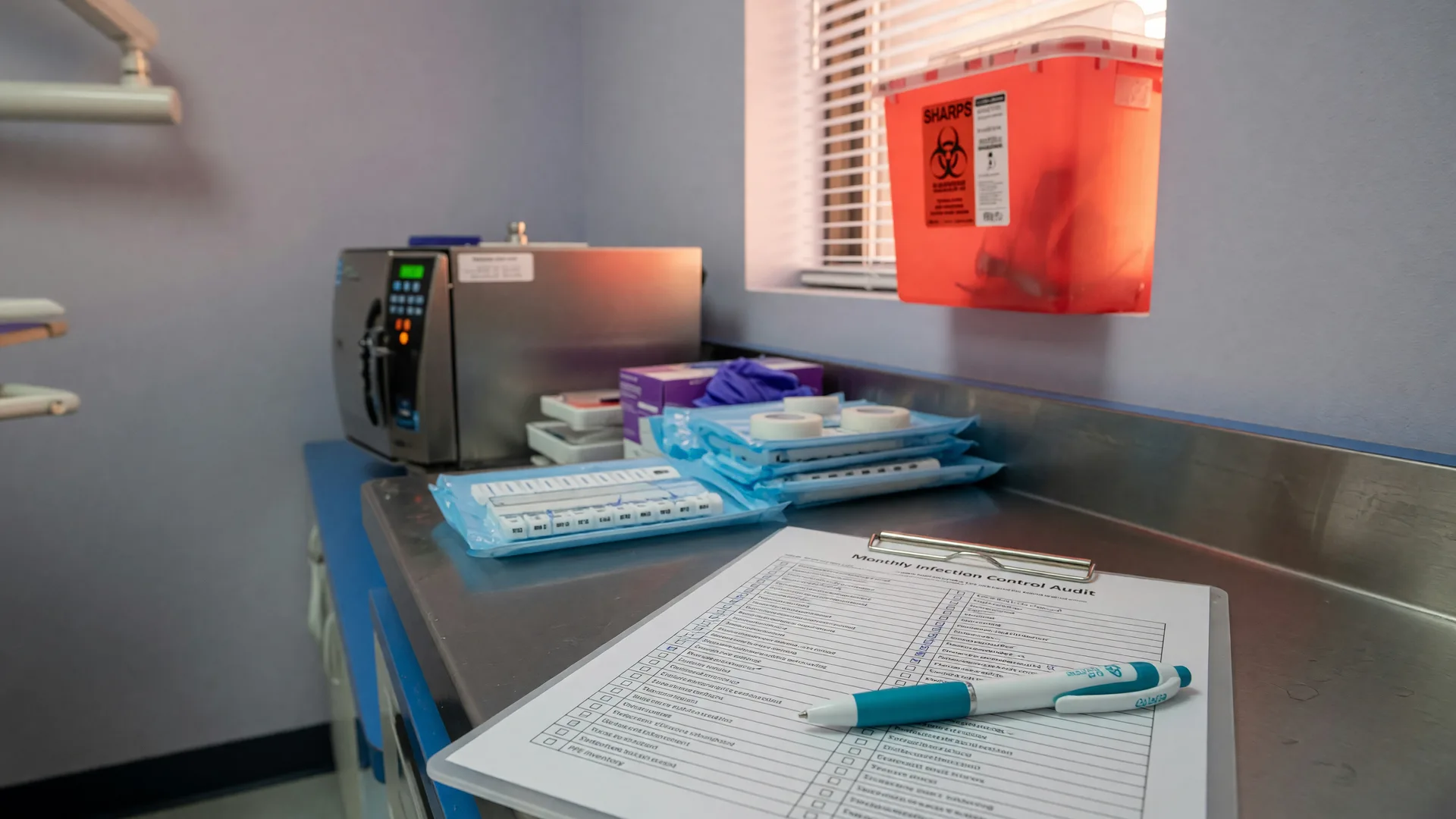
A dental office self-audit is a structured walk through your own practice using the same infection control and OSHA requirements the Nevada State Board of Dental Examiners (NSBDE) enforces. Do one at least once a year, and fix what you find: under OSHA's policy on voluntary self-audits, correcting a gap before the inspector arrives works in your favor, and in Nevada, NAC 631.178 holds every practice to continuous compliance with the CDC guidelines. As a former NSBDE infection control inspector, I can tell you the practices that audit themselves are rarely the ones that get caught off guard.
Most owners already believe their office is compliant. Nearly every practice that calls me says so, and about half are right once we finish the audit. The difference between checking a box and actually being ready usually comes down to knowing what to look at, in what order. This guide gives you the full route, so you can find the gaps yourself, on your own schedule, before an inspector finds them for you.
Why Should a Dental Practice Do a Self-Audit?
The short answer: it is cheaper and calmer to catch a problem on your own terms than to learn about it during an inspection. Nevada dentistry is regulated through NAC 631.178, which adopts the CDC's Guidelines for Infection Control in Dental Health-Care Settings and the Guideline for Disinfection and Sterilization in Healthcare Facilities as binding requirements. Under NAC 631.1785 the board classifies deficiencies and requires correction, and under NAC 631.179 it can conduct unannounced inspections.
Owners sometimes worry a written self-audit could be used against them. OSHA addressed that concern in its final policy on voluntary employer self-audits, published July 28, 2000. Inspectors do not routinely request your audit report, they do not cite hazards you corrected before the inspection, and an audit with fixes underway reads as evidence of good faith. The most dangerous document on your shelf is not the audit. It is the inspection report you never saw coming.
Where Do You Start a Self-Audit in a Dental Office?
Start with three things: a quiet hour, a written checklist, and your file system. Sit down before you walk the operatory so you know what your paperwork says today. Bring the compliance binder, the exposure control plan, the training logs, and the sterilization and waterline records. The board will review those first, so you should too; there is little point adjusting the PPE station if training documentation is missing for the last two team members.
If you do not have a compliance binder at all, you have already found your first issue, and that is fine. An audit that confirms everything is perfect is a wasted hour; an audit that surfaces the real gap is the most useful hour you will spend this quarter. For the document half of the walk, our infection control record-keeping guide lists exactly what the NSBDE asks to see, item by item.
How Do You Audit Your Written Exposure Control Plan?
The exposure control plan is the backbone of the OSHA bloodborne pathogens standard, 29 CFR 1910.1030. Open yours and verify these five elements:
A current exposure determination. List every position in the office where a worker could reasonably come in contact with blood or other potentially infectious materials, from the clinical team to the person who cleans a contaminated operatory.
A documented annual review. OSHA requires the plan to be reviewed and updated at least once a year, and every review should be documented in writing. I have walked into offices with a plan dated five years ago and a team that changed twice since. If a job description changed, a new position was created, or a new assistant started, the plan must change with it.
Hepatitis B records. The vaccine must be offered at no cost to every at-risk employee within 10 working days of hire, and you keep each employee's vaccination record or a signed declination form.
Engineering and work practice controls. List the safer sharps devices you use, evaluate whether new devices are available at least annually, and document that evaluation.
Training and exposure records. Keep the training dates for every clinical employee plus the exposure incident log. The paperwork mistakes offices make after a needle stick are covered in depth in our exposure incident article.
If any of the five is missing, you are not fully ready yet, even if every drawer is stocked with gloves. The plan is the piece most practices try to write alone and get halfway right. If you are unsure about the language, this is the highest value place to bring in expert help; our infection control consulting page explains how we review and rebuild plans for Nevada practices.
What Should You Check When You Walk the Operatory?
Once your paperwork is in order, walk the physical space with fresh eyes, the way an inspector does, starting at the counter and working to the corners.
Sharps. Check that sharps containers are intact, puncture-resistant, closable, labeled, and within arm's reach of the point of use. No needle should cross the room in someone's hand because a container was moved to the other counter. Fill the container to the marked line, never to the rim. The rule has not changed: no two handed recapping, ever. These mistakes are covered in our sharps safety article.
PPE at every point of use. Each working area should have gloves in the right sizes, masks, and eye protection. Check for rerolled gloves, masks hanging long enough to touch a contaminated surface, and face shields that are scratched enough to be half armor. Our PPE rules by procedure is a good at-a-glance reference to keep in the break area.
Sterilization flow. Trace one instrument from the operatory into the processing area: clean must move one direction and never back across the dirty bench. Each autoclave run should carry its date, operator initials, and cycle number, with spore testing linked to the load. The sterilization workflow guide walks this zone in detail.
Waterlines. Pull your waterline log and check for flushing records and quarterly test results per operatory, with results no older than the interval your unit manufacturer requires. Our waterline testing guide covers collection and documentation.
Labels and waste. Red bags with the biohazard symbol hold regulated medical waste, no infectious waste goes in a regular trash bag, and the SDS binder sits where staff can actually find it, not in a locked supply closet.
What Do You Do With the Findings From Your Self-Audit?
Sort findings by severity. Anything that could injure a patient or a staff member today gets fixed today, no exceptions: stop the use of a faulty sterilizer, a full sharps container, or a compromised waterline right away. Anything that is a training gap gets a session this week. The rest go on a 30 day calendar with a named owner, and you record what you found and when it was fixed. A practice that can show it caught and corrected its own issue looks completely different from one that let it sit.
Do You Need To Report Your Self-Audit Results?
Typically, no. A self-audit is internal, not a submission. OSHA's 2000 policy means your voluntary audit records are not routinely requested at the start of an inspection, and Nevada's state OSHA program follows the same federal framework. The board inspects under its own NAC rules and does not ask to see your private walk-through. Correct the gaps and keep the records for the same reason you keep everything else: you can show the work was done honestly. The one exception is a true imminent risk: stop the activity, pull the equipment or the exposure out of service, and correct it immediately.
What Are the Most Common Self-Audit Findings in Nevada Dental Offices?
Across the Nevada offices I inspected and later consulted for, the same five gaps show up in most audits: an exposure control plan that is out of date, sharps habits living in the team's memory rather than in the policy, training you cannot prove because the records are incomplete, spore tests that happened but were never linked to the load, and a binder nobody can find on inspection day. None are expensive to fix. They are all easy to miss until someone walks the room on purpose.
If you would rather not audit alone, that is exactly what we do for a living. Our infection control audits cover the same ground with the same inspector lens and end with a written report and a fix list sorted by risk. We also turn the findings into team practice via staff training workshops, so the corrected habit stays corrected. Contact us and we will size the audit to your practice and your calendar.
An office that looks effortless at inspection time is rarely lucky. It has simply been walked, read, and corrected once already, and the walk did not hurt. Do it once, schedule the next one, and stay ahead of every surprise visit the board can bring.
Want a Second Set of Inspector Eyes?
Let a former NSBDE inspector review your compliance program, run the same audit end to end, and hand you a written fix list you can act on this week.
Book Your Audit