
How Long Should You Keep Dental Infection Control Records?
A former NSBDE inspector explains how long Nevada dental practices must keep training, medical, sterilization, and sharps records under OSHA and NAC rules.
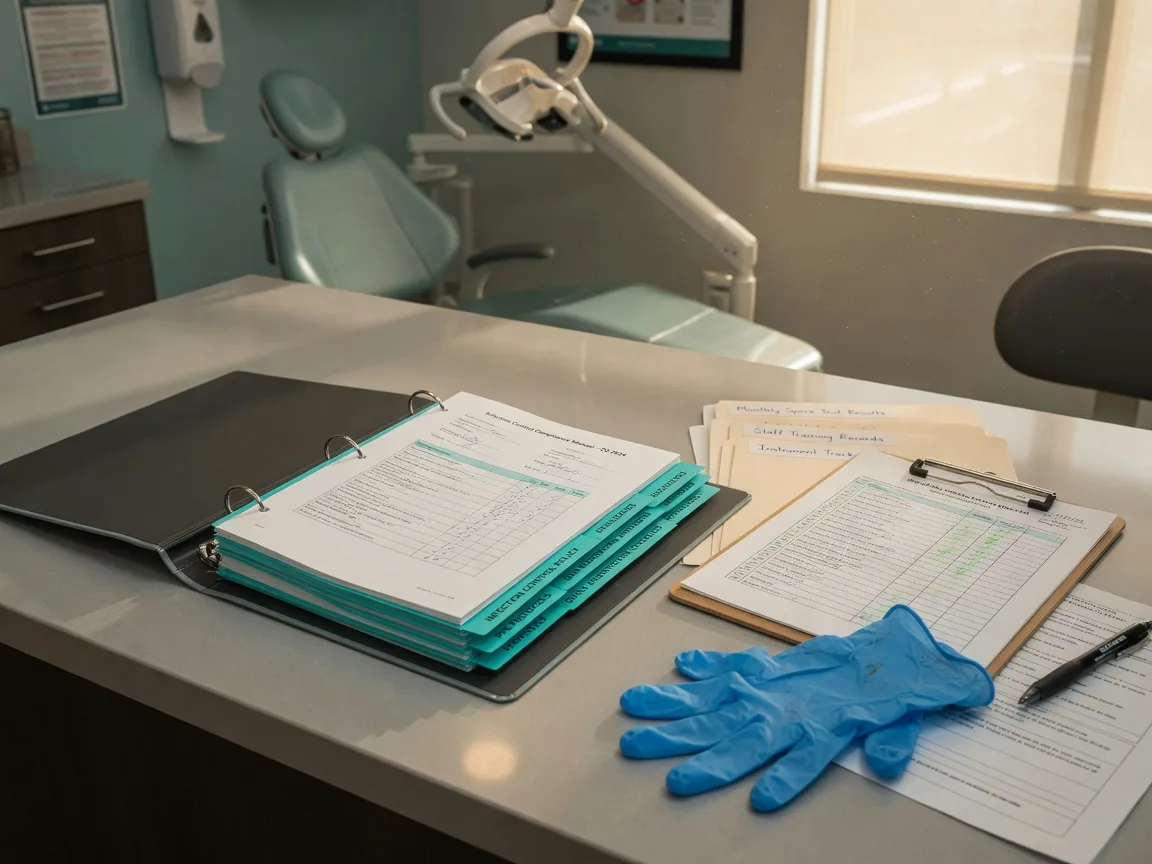
The short answer is three years, five years, or the duration of employment plus thirty years, depending on the document. Bloodborne pathogens training records must be kept for 3 years from the date of training under 29 CFR 1910.1030(h)(2). The sharps injury log must be kept for 5 years following the end of the calendar year it covers under 29 CFR 1904.33. Employee medical records, including hepatitis B vaccination status and post-exposure evaluations, must be kept for the duration of employment plus 30 years under 29 CFR 1910.1020(d)(1)(i). Sterilization and spore testing logs have no fixed federal number, but Nevada's board expects a continuous, unbroken record. As a former NSBDE infection control inspector, I can tell you that how long you keep a record matters as much as what is in it.
Most Nevada dental offices do not lose inspections because a record is wrong. They lose them because a record is missing, or because it was thrown out too soon. I have walked into practices where the training file stopped the day the office manager quit, and where last year's sharps log had been recycled to make space. Both are easy to fix once you know the retention rules. This guide covers every record category, what the regulation says, and how long to keep it. For the full picture of what the board looks for, start with our companion guide on record-keeping for infection control.
How Long Must Dental Offices Keep Bloodborne Pathogens Training Records?
Three years from the date of each training session. That is the rule in 29 CFR 1910.1030(h)(2), and it applies to every employee with occupational exposure: dentists, hygienists, assistants, and front desk staff who handle contaminated instruments or surfaces. The record must include the date, a summary of the content, the name and qualifications of the trainer, and the names and job titles of everyone who attended.
Here is what trips practices up. The three-year clock restarts with every training session, so you cannot keep one folder labeled "training" and call it done. You need a running log with an entry for each session, each year, for each employee. When an inspector asks for the training record of a hygienist who started in 2024, you should be able to hand over every session since her hire date, not just the latest.
A practical tip: keep training records in the same binder as your exposure control plan, organized by year, and add a page with every new session. When an employee leaves, file their records with their personnel file rather than deleting them. The three-year requirement is a minimum, not a suggestion to shred at month 37.
How Long Do Employee Medical Records Need to Be Kept?
Medical records are the longest retention category in infection control compliance. Under 29 CFR 1910.1020(d)(1)(i), employee medical records must be kept for the duration of employment plus 30 years. That covers hepatitis B vaccination status, the signed declination form if an employee refused the vaccine, post-exposure evaluation records, and the written opinion from the healthcare professional after an exposure incident.
Thirty years sounds like a long time, and it is. There is a reason the rule exists. Bloodborne pathogen exposures can have long latency periods, and both the employee and the employer may need those records decades later. OSHA's access-to-records standard exists so employees can review their own exposure and medical history. If the record is gone, that right is gone too.
One nuance: for employees who worked less than one year, the employer may give the medical records to the employee at termination instead of keeping them. Most practices never use this option, and I recommend you do not either. Keeping the records in the practice's files is simpler and safer. When in doubt about which category a record belongs to, keep it. The cost of a filing cabinet is nothing compared to explaining a missing hepatitis B record to the board.
How Long Must You Keep the Sharps Injury Log?
Five years following the end of the calendar year the log covers, per 29 CFR 1904.33. The sharps injury log is required under 29 CFR 1910.1030(h)(5) for every percutaneous injury from a contaminated sharp. Each entry must record the date, the type and brand of the device, the department or work area where the exposure occurred, and a brief description of the incident, with employee confidentiality protected.
Because the retention period runs from the end of the calendar year, a log that covers 2026 must stay on file until the end of 2031. Practices that treat the sharps log like a scratchpad, or start a new log each year and discard the old one, are the ones I saw in trouble. The board and OSHA both want a continuous history.
The sharps injury log is also the record that connects to your exposure incident paperwork. Every entry should trace back to a documented post-exposure evaluation, including source testing, employee blood testing with consent, and the written opinion from the healthcare professional. If your incident documentation is incomplete, our guide on staff exposure incident paperwork walks through the exact records you need.
How Long Should Sterilization and Spore Testing Records Be Kept?
This is the question I got most often as an inspector. The honest answer is that no regulation sets a single magic number, but the expectation is a continuous, unbroken record. NAC 631.178 adopts the CDC's infection control guidelines for dental settings by reference, and those guidelines require biological monitoring of sterilizers at least weekly, with the results documented and maintained. The NSBDE verifies sterilization and spore testing logs during inspections under NAC 631.1785 and 631.179.
So what does that mean in practice? Keep your spore testing log, chemical indicator records, and mechanical monitoring records for every sterilizer load, for years, not months. My recommendation is to retain sterilization records for at least 3 years, and ideally for the life of the sterilizer. A board inspector will often pick a random date from the past and ask to see the matching entry. If your log only goes back six months, you cannot answer, and a gap reads as "we were not testing" even when you were.
The same logic applies to failed spore tests. A failure is a problem, but a failure with no corrective action documentation is a bigger one. Record the date, the sterilizer involved, what you did, and the successful retest, and keep that paper trail as long as the log itself. For the full sterilization workflow, including autoclave placement and monitoring, our sterilization room article covers it in detail.
What About the Exposure Control Plan and Hazard Communication Records?
Your written exposure control plan does not have a fixed retention number, because it is a living document. Under 29 CFR 1910.1030(c)(1)(iv), it must be reviewed and updated at least annually, and whenever changes in tasks, procedures, or technology affect occupational exposure. Keep the current version accessible, and keep prior versions on file so you can show the review history. A plan that has not been touched in three years is not a record-keeping problem; it is a compliance problem.
Safety data sheets are a different story. Under 29 CFR 1910.1020(d)(1)(ii), chemical exposure records, which include safety data sheets, must be kept for at least 30 years. In practice, that means your SDS binder should hold the sheets for every chemical currently in the practice, plus sheets for chemicals you have discontinued, at least for the retention window. When you switch surface disinfectants, file the old SDS rather than throwing it away.
Hazard communication training records follow the same 3-year rule under 29 CFR 1910.1200. If you train your team on both topics in one session, keep a single record that documents both, with the content summary covering each standard.
What Happens If You Cannot Produce a Record During an Inspection?
The NSBDE issues demerits, not citations, and accumulated demerits put a license at risk. A missing record is a demerit even when the underlying practice was fine, because the board cannot verify what you cannot show them. An inspector's job is to verify, not to take your word. Nevada OSHA, enforced through the Nevada Division of Industrial Relations, can also issue citations with penalties for missing training or medical records.
The practical takeaway is that retention is a habit, not a project. Set a quarterly reminder to check the compliance binder. When a record's retention window ends, do not shred it automatically; review it once, then decide. When in doubt, keep it longer. Storing paper is cheap. A demerit is not.
If you want to know exactly where your practice stands, a self-audit is the fastest way to find out. Our step-by-step self-audit guide walks you through every record category with a checklist you can run in an afternoon. And if you would rather have a former NSBDE inspector do it for you, our infection control consulting services include a full document audit with a written report of findings.
Need a Document Audit?
Let a former NSBDE inspector review your records using the same checklist used during board inspections. We will tell you what to keep, what to fix, and what to add before your next visit.
Schedule Your Audit