
Needlestick at Work: What to Do in the First 24 Hours
A former NSBDE inspector walks Nevada dental offices through the first hours after a needlestick: first aid, post-exposure medical evaluation, source testing, and the OSHA paperwork.
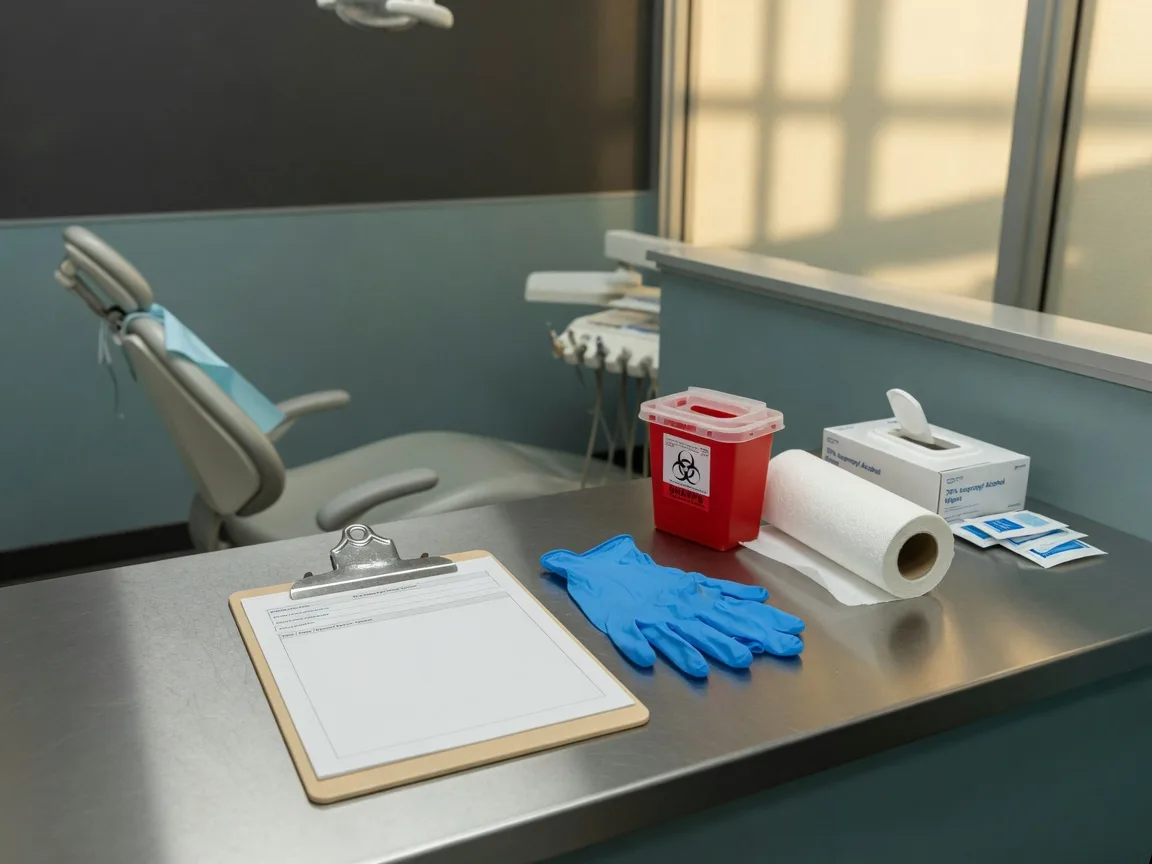
A needlestick happens in a second, but what the team does in the next 24 hours shapes the whole outcome. If an employee is exposed to blood or another potentially infectious material, the immediate priorities are to wash the exposure site, report the incident, and start a medical evaluation as fast as possible, because post-exposure treatment is time-sensitive. Under the OSHA Bloodborne Pathogens Standard (29 CFR 1910.1030(f)), the employer must make a confidential post-exposure medical evaluation available at no cost, without delay, whenever an employee reports an exposure incident. Nevada reaches the same expectation through NAC 631.178, which adopts the CDC's Guidelines for Infection Control in Dental Health-Care Settings by reference, and those guidelines list the same first steps: wash, report, evaluate. Here is the timeline I walked dental teams through as an NSBDE infection control inspector.
What Is the First Thing to Do After a Needlestick in a Dental Office?
The first minutes belong to first aid, straight from the CDC guidance Nevada's board adopts by reference. For a needlestick or a cut, wash the area thoroughly with soap and water. For a splash to the nose or mouth, flush the area with water. For a splash to the eyes, irrigate with clean water, saline, or sterile irrigant as soon as possible. Do not squeeze the wound, and do not wait until the patient leaves the chair to start. In the middle of a procedure, the assistant can hand the room off while the injured team member heads for the sink.
Second, report the incident to the designated supervisor. Your written exposure control plan should name that person and include after-hours contacts. Across southern Nevada, the after-hours gap was one of the most common failures I saw: the plan said "call the office," but nobody had posted the doctor's cell number or the urgent care contact. An exposure at 5:30 on a Friday needs a plan written on a Tuesday. Third, the employee proceeds to the scheduled medical evaluation, because the window that matters is the first hours, not the first days.
When Must a Dental Office Offer Post-Exposure Medical Evaluation?
Immediately. The regulation uses that word on purpose. Under 29 CFR 1910.1030(f)(3), the employer must make available, immediately after an exposure incident is reported, a confidential medical evaluation and follow-up at no cost, at a reasonable time and place, performed by or under the supervision of a licensed physician or another licensed healthcare professional. Nevada OSHA (NVOSHA), part of the Nevada Division of Industrial Relations, enforces the same standard in Nevada, so there is no shortcut around it.
"Immediately" matters because prophylaxis is a clock race. Public health guidance is clear: HIV post-exposure prophylaxis works best when started as soon as possible, ideally within hours. For hepatitis B, post-exposure prophylaxis with vaccine and, when indicated, hepatitis B immune globulin, is most effective when started within 24 hours, and the decision depends on the employee's vaccination status. That is why the evaluation cannot wait for a convenient opening in the schedule. Agree on a medical provider in advance, usually an occupational health or urgent care clinic, so the process is a phone call and a walk over.
What Does the Post-Exposure Evaluation Actually Include?
The evaluation has four pieces under 29 CFR 1910.1030(f)(3). The clinician documents the route of exposure and the circumstances. The source individual is identified and, with consent, their blood is tested for HBV and HIV infectivity as soon as feasible. The exposed employee's blood is collected and tested as soon as feasible after consent; if the employee accepts the draw but declines HIV testing, the blood is held for 90 days in case they change their mind. Prophylaxis follows U.S. Public Health Service recommendations, plus counseling and evaluation of any reported illnesses.
The office's job is to hand the clinician everything they need: under 29 CFR 1910.1030(f)(4)(ii), a copy of the regulation, a description of the employee's duties as they relate to the exposure, documentation of the route and circumstances, the source's available test results, and the employee's relevant medical records including vaccination status. Without the vaccination record, the clinician cannot make the hepatitis B decision correctly. Keep a vaccination status summary in each clinical employee's confidential file.
Within 15 days, the employer must obtain and give the employee the healthcare professional's written opinion under 29 CFR 1910.1030(f)(5). It is deliberately limited: for hepatitis B, only whether vaccination is indicated and whether the employee received it; for the exposure, only that the employee was informed of the results and any conditions needing further evaluation or treatment. Everything else stays confidential and out of the practice's general personnel file.
Can a Dental Office Test a Source Patient Without Consent in Nevada?
Testing the source patient requires consent. Under 29 CFR 1910.1030(f)(3)(ii), the employer must identify and document the source individual, and the source's blood must be tested as soon as feasible after consent is obtained. If the source refuses, the employer documents that legally required consent cannot be obtained. If the source is already known to be infected with HBV or HIV, no repeat testing is needed. The exposed employee is entitled to the source's test results and to information on the laws governing disclosure of the source's identity and status.
In practice, this is a conversation, not a confrontation: a private request, a clear reason, and most patients agree. When they do not, the refusal and the attempt go in the exposure file. One caution I repeated often: keep the source patient's identity out of the sharps injury log, because mixing patient identifiers into it creates a confidentiality problem the board takes seriously.
What Paperwork Completes an Exposure Incident File?
The documentation builds in layers, each with its own deadline. Start with the incident report: date and time, who was involved, the device and procedure, the route of exposure, how it happened, first aid rendered, and who was notified. Then make the sharps injury log entry. Under 29 CFR 1910.1030(h)(5), it must record at minimum the type and brand of device, the work area, and an explanation of how the incident occurred, with the injured employee's identity kept confidential. Expect the NSBDE to look for a complete sharps injury log even in smaller offices partially exempt from the federal OSHA 300 Log.
If your practice must keep OSHA logs (generally 11 or more employees at any time in the last year), every needlestick or sharps cut involving another person's contaminated device must be entered on the OSHA 300 Log with a 301 Incident Report within 7 calendar days, under 29 CFR 1904.8 and 1904.29(b)(3), even when no treatment beyond first aid was needed. Then the file holds the written opinion and the follow-up notes. Employee medical records, including hepatitis B vaccination status and the post-exposure evaluation, stay confidential for the duration of employment plus 30 years under 29 CFR 1910.1020(d)(1)(i). For the full rundown of what the board checks and how long to keep each document, read our companion guides on staff exposure incidents: the paperwork most offices get wrong and record-keeping for infection control: what the board actually looks for.
"The offices that handle exposures best treat them as a protocol: wash, report, evaluate, document, prevent. The team already knows the steps, because they practiced them before an incident happened."
How Can Nevada Dental Practices Prevent the Next Exposure?
Response matters, but prevention is where you keep your team whole. Start with engineering controls: safety-engineered sharps devices, self-sheathing needles, retractable systems. They eliminate most needlesticks before they happen, and the Needlestick Safety and Prevention Act requires that clinical staff help select them. If your operatory still uses the same anesthetic syringes it used fifteen years ago, start there. Our guide on common sharps safety mistakes in Nevada dental offices covers the full checklist.
Then make the response drill part of annual training. Every team member with occupational exposure needs bloodborne pathogens training at hire and annually, documented and ready to show the board. Include a hands-on walkthrough: where the sharps containers are, how to reach the post-exposure provider, who makes the after-hours call, and the first aid steps for a splash versus a stick. Our staff training programs are built around exactly this kind of drill. Add the exposure checklist to your quarterly dental office self-audit, and review the exposure control plan every year, because a plan is only real if the team can act on it at 5:30 on a Friday.
In Nevada, the board issues demerits, not citations, for infection control gaps, and accumulated demerits put a license at risk. But the cost that matters more is human: a team member waiting on results, unsure what happens next. A written protocol, a named provider, and a trained team turn a frightening moment into a handled process. Want inspector-trained eyes on your exposure control plan before an incident tests it? Contact Thrive Professional Solutions to schedule a compliance audit. We serve dental practices across the Las Vegas Valley, Henderson, Summerlin, and southern Nevada.
Review Your Exposure Control Plan
Let a former NSBDE inspector audit your exposure response protocol, training records, and sharps injury log before an incident tests them.
Schedule an Audit